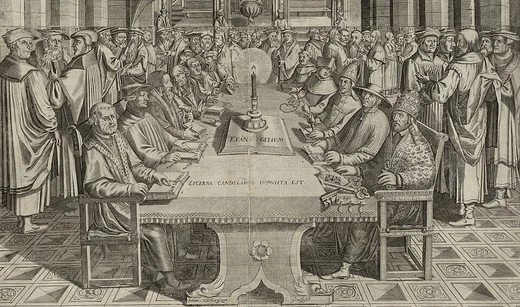
Jacobus Arminius
Dutch Reformed theologian whose views sparked the Synod of Dort.

Jacobus Arminius (Dutch: Jakob Hermanszoon; 10 October 1560 – 19 October 1609) was a Dutch Reformed minister and theologian during the Protestant Reformation period. His views became the basis of Arminianism and the Dutch Remonstrant movement. He served from 1603 as professor in theology at the University of Leiden and wrote many books and treatises on theology. Following his death, his challenge to the Reformed standard, the Belgic Confession, provoked ample discussion at the Synod of Dort, which crafted the five points of Calvinism in response to Arminius's teaching.
- born
- 1559 or 1560, Oudewater, Utrecht, Netherlands
- died
- 19 October 1609
- field
- Theology
- nationality
- Dutch
- known_for
- Foundational figure of Arminianism and the Dutch Remonstrant movement
Lore & Background
Jakob Hermanszoon was born in 1559 or 1560 in Oudewater, Utrecht, Netherlands. He became an orphan while still young; his father Herman, a weapons manufacturer, died, and his mother was killed during the Spanish massacre at Oudewater in 1575. He was adopted by Theodorus Aemilius, a priest inclined toward Protestantism, and around 1572 settled with him in Utrecht. After Aemilius's death (1574 or 1575), mathematician Rudolph Snellius brought Arminius to Marburg and enabled him to study at Leiden University. Arminius studied at Leiden from 1576 to 1582, with teachers including Calvinist Lambertus Danaeus, Hebrew scholar Johannes Drusius, Guillaume Feuguereius, and Johann Kolmann, who taught that the overemphasis of God's sovereignty in high Calvinism made God 'a tyrant and an executioner.' In 1582 he studied under Theodore Beza at Geneva, where he was publicly forbidden to teach Ramean philosophy. He moved to Basel, and in 1583 the theological faculty there spontaneously offered him a doctorate, which he declined on account of his youth (about 24). He returned to Geneva to finish his schooling under Beza. Beza later wrote to Amsterdam leaders in a letter of 3 June 1585, calling Arminius 'a young man, unquestionably, so far as we are able to judge, most worthy of your kindness and liberality.' John Grynaeus at Basel also commended him in a letter of 3 September 1583, noting his 'piety, moderation, and assiduity in study.'
Reader's Guide
Arminius answered the call to pastor at Amsterdam in 1587, delivering Sunday and midweek sermons, and was ordained in 1588. One of his first tasks was to refute the teachings of Dirck Coornhert, who rejected Beza's supralapsarian doctrine. Arminius readily agreed but after greater study was conflicted. In 1590 he married Lijsbet Reael, daughter of prominent merchant Laurens Jacobsz Reael. He was commissioned to organize Amsterdam's educational system and did it well. During a plague in 1602, he went into infected houses to give water and supplied neighbors with funds to care for the sick. In 1591, teaching through Romans 7, he taught that man through grace and rebirth did not have to live in bondage to sin, leading some detractors to label him Pelagian. His colleague Petrus Plancius openly disputed him. Arminius insisted he taught nothing in contradiction to the Heidelberg Confession and repudiated Pelagianism. The Amsterdam burgomasters intervened, urging him to teach nothing out of accord with Reformed thought unless he consulted the church council. Later, preaching through Romans 9, he focused on 'justification by faith' rather than God's eternal decrees, gradually developing opinions on grace. After his death, his challenge to the Belgic Confession provoked ample discussion at the Synod of Dort, which crafted the five points of Calvinism in response to his teaching.
Did You Know?
- Arminius's mother was killed during the Spanish massacre at Oudewater in 1575.
- He was offered a doctorate by the theological faculty at Basel in 1583 but declined because he was about 24 years old.
- During a plague in Amsterdam in 1602, Arminius went into infected houses to give water and supplied neighbors with funds to care for the sick.
- Beza wrote a letter on 3 June 1585 commending Arminius as 'most worthy of your kindness and liberality.'
- Arminius's colleague Johann Kolmann taught that the overemphasis of God's sovereignty in high Calvinism made God 'a tyrant and an executioner.'
Orphanhood and the Seeds of a Theologian
Jakob Hermanszoon entered the world in Oudewater, in the province of Utrecht, around 1559 or 1560, into a household where his father Herman worked as a weapons manufacturer. That father died when Jakob was still a small child, leaving his mother to raise several young ones alone. The boy thus grew up without ever knowing his father's presence. Tragedy struck again in 1575, when Spanish forces carried out a massacre at Oudewater and his mother was among those killed. The orphaned child was taken in by Theodorus Aemilius, a priest with sympathies toward Protestantism. Around 1572, the year Oudewater fell to rebel forces, the pair relocated to Utrecht, where the young Jacobus attended what was likely the Hieronymusschool. After Aemilius himself passed away in 1574 or 1575, the boy crossed paths with the mathematician Rudolph Snellius, a fellow Oudewater native. Snellius became a crucial patron, escorting the teenager to Marburg and ultimately arranging for him to enroll at the University of Leiden, setting in motion a career that would reshape Reformed theology.
A Mind Forged Between Leiden, Geneva, and Basel
From 1576 to 1582, Arminius studied at Leiden, officially in liberal arts but deeply engaged in theology. His mentors included the Calvinist Lambertus Danaeus, Hebrew scholar Johannes Drusius, Guillaume Feuguereius, and Johann Kolmann, whose teaching that excessive stress on divine sovereignty could make God seem like a tyrant would later echo in Arminius's own thought. The university, though firmly Reformed, also carried Lutheran, Zwinglian, and Anabaptist currents. A local pastor, Caspar Coolhaes, argued against Calvin that civil authorities had a role in certain church matters and that executing heretics was wrong. The mathematician Willebrord Snellius encouraged students to seek truth through Ramist method rather than relying solely on Aristotle. These diverse influences planted seeds that would eventually challenge dominant Calvinist theology. His academic success earned him a three-year stipend from the Amsterdam merchants' guild. In 1582 he moved to Geneva to study under Theodore Beza, but friction arose over his use of Ramist methods; he was publicly barred from teaching Ramean philosophy. He then transferred to Basel, where he continued to excel. In 1583 the Basel theological faculty spontaneously offered him a doctorate, which he declined on the grounds of his youth and returned to Geneva to complete his training.
Praise from the Giants of Reformed Theology
Before Arminius ever stepped into a pulpit, two of the most prominent figures in Reformed scholarship wrote glowing letters of recommendation. Theodore Beza, Calvin's successor at Geneva, told Amsterdam's leaders in June 1585 that Arminius's life and learning had so impressed them that they hoped for the best in every respect. Beza singled out the young man's intellect as well suited to both grasping and discriminating between ideas, and expressed confidence that if guided by piety, that mind would bear the richest fruits in maturity. Three months earlier, John Grynaeus, dean of the theological faculty at Basel, had written praising Arminius's deportment as marked by piety, moderation, and assiduous study. Grynaeus noted that in theological discussions Arminius repeatedly displayed a discerning spirit that drew congratulations from his peers. He also highlighted a series of extraordinary prelections, delivered with the faculty's consent, in which Arminius publicly expounded chapters of the Epistle to the Romans, giving grounds to hope he was destined for the teaching function. Both letters made clear that the earlier tension over Ramist philosophy had dissipated, and that Arminius was recognized even by his strictest mentors as an outstanding, if still budding, theologian.
The Controversy That Outlived Him
Arminius served as professor of theology at the University of Leiden from 1603 until his death on 19 October 1609, during which period he produced numerous books and treatises on theological subjects. His theological positions, however, carried consequences far beyond the lecture hall. His challenge to the Reformed standard embodied in the Belgic Confession provoked ample discussion after his passing. The Synod of Dort convened to address the questions his teaching raised, and the assembly crafted the five points of Calvinism as a direct response to Arminius's positions. His views became the foundation of what is known as Arminianism and gave rise to the Dutch Remonstrant movement, a distinct current within Protestant theology. In this way, a man who died at the age of forty-nine left a theological legacy that fundamentally reshaped the internal landscape of Reformed Christianity. The controversy he set in motion ensured that his name would remain inseparable from one of the most consequential doctrinal debates in the history of the Protestant Reformation.
Frequently Asked Questions
Who is Jacobus Arminius?
He was a Dutch Reformed minister and theologian born in Oudewater, Utrecht, around 1560, who later became a professor of theology at the University of Leiden. He is best remembered as the intellectual founder of Arminianism and the Dutch Remonstrant movement.
What did Jacobus Arminius actually teach?
Arminius challenged the strict Calvinist reading of the Belgic Confession, particularly on matters of predestination and the scope of atonement. His emphasis on God's foreknowledge and genuine human free will became the backbone of what we now call Arminian theology.
What happened at the Synod of Dort in relation to Arminius?
Although Arminius himself died in 1609 before the synod convened, his followers—the Remonstrants—brought his questions to the 1618–1619 assembly. The Synod of Dort responded by codifying the Five Points of Calvinism (TULIP) as a direct rebuttal to Arminian positions.
Where did Jacobus Arminius study and work?
He held a professorship in theology at the University of Leiden starting in 1603, a position he occupied until his death on 19 October 1609. During that time he produced numerous books and treatises on Reformed theology.
Why does Jacobus Arminius still matter to Protestant theology today?
His theological questions forced the Reformed tradition to articulate and defend its soteriology more precisely, giving rise to the Calvinist–Arminian debate that continues in churches worldwide. He remains the foundational figure behind the Remonstrant Church and a major alternative voice within Protestant thought.
More in Protestant Reformers & Theologians 1-24
Related in Protestant Reformers & Theologians
Links follow this subject's own source article.
Spotted an error? Know more?
This is a living reference — every entry is fact-audited, and reader corrections feed straight into our audit queue. Suggest an edit · See this site's audit record